gtbuy Finds: Buy by Use Case
gtbuy Finds: Buy by Use Case
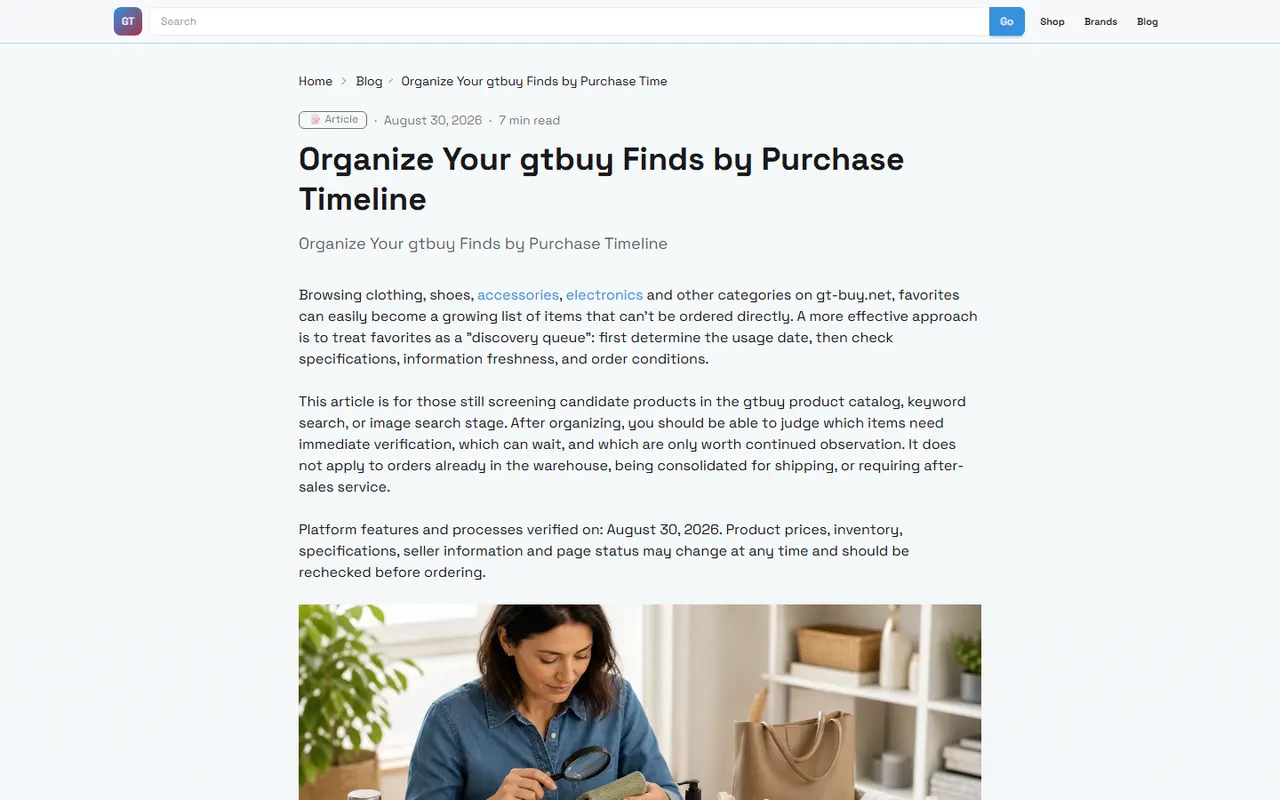
gtbuy Finds: Buy by Use Case
When your favorites list contains travel items, daily necessities, and alternative candidates at the same time, the most common problem is not that you don't know how to search, but that you add all the items to your purchase list at once. This makes it difficult to judge priorities and can also make budgeting, storage arrangements, and subsequent inspection chaotic.
This guide addresses one clear task: converting the candidate items saved on gt-buy.net into a first purchase batch and a follow-up observation list based on actual use cases. After reading, you should be able to first address imminent travel necessities while retaining alternative items that are not suitable for ordering right now.
This article does not apply to large-volume orders where size, material, inventory, seller, final cost are already confirmed, and immediate purchase is mandatory. For such orders, you should still verify item pages and current platform procedures item by item. This article also does not replace destination country's import, tax, or customs clearance requirements.
First map favorite candidates to specific use cases
After opening your favorites, don't start by checking whether product names are attractive. Instead, answer what situation the item is intended for. A candidate item should correspond to at least one clear scenario, for example:
Upcoming travel, needing use before a fixed date
Daily commute or home use
Specific seasonal or short-term activity use
Replacement need after damage to existing item
Just thinking the design is nice, with no clear purpose yet
If a candidate item cannot be mapped to a specific scenario, don't put it into the first purchase batch. You can keep it, but mark it as pending observation, rather than treating the act of favoriting as a purchase commitment.
For each candidate item, add a sentence: "At what time, in what place, and for what task will I use this?" For example, "for packing a change of clothes on next month's business trip" is better for judging priority than just "travel bag," because it states the use time, scenario, and functional requirements.
When viewing candidate items on gt-buy.net, rely on the information visible on the current product page. Product names, specifications, colors, sizes, materials, seller information, and page status may all change; the favorites list itself does not prove that the item is still suitable for purchase.🔎
Distinguish must-solve-now needs from those that can wait
After writing down the scenarios, layer by time pressure. We recommend using three categories:
The first category is travel necessities. The item must arrive before a clear date, and lacking it will directly affect the itinerary. Examples include luggage organizers, clothing suited to destination weather, or must-use accessories during travel. Such candidates should be prioritized for checking page information, available specifications, and expected process.
The second category is useful soon but can be substituted. The item is indeed helpful, but you already have a temporary alternative, or the travel date is not approaching. Such candidates can go into a second batch, first observing whether information is complete, prices are stable, and whether it's worth merging with the first batch.
The third category is interest favorites. The item currently has no clear usage date and causes no practical problem by its absence. Such candidates can remain, but should not be automatically purchased just because the number of favorites increases.
You can use a simple test: If the item arrives a week late, will it affect already made plans? If the answer is "yes," it is high priority; if it merely reduces convenience, it can usually wait; if there is no specific impact, it should not be placed before the first batch.
Set specification and quantity limits for each scenario
For the same scenario, first determine the task requirements, then compare items. Don't assume that because you have multiple similar candidates in favorites, each needs to be purchased.
We recommend setting the following limits for each scenario:
Must-meet specifications, such as size, capacity, interface, season, or applicable range
Acceptable alternative specifications
Maximum quantity for the first batch
Acceptable per-item budget or scenario budget
Unacceptable flaws, such as missing information, unclear specifications, or page not loading properly
For example, for a travel organizer scenario, you can first decide whether you need one main organizer, then decide if you need additional small items. If the first item already fulfills the main task, the second should become a backup, not be purchased simultaneously just because the appearance differs.
For clothing, shoes, or items that contact the body, also record size and measurement requirements separately. When the product page lacks sufficient size information, do not fill in data using adjacent items, image proportions, or subjective impressions.
An actionable batch division can be:
Batch | Suitable candidates | Key checks before ordering |
|---|---|---|
First batch | Clear usage date, no substitute available | Page accessibility, specifications, quantity, seller, and current cost information |
Second batch | Items with near-term use but can wait | Whether they complement the first batch, whether better substitutes exist |
Keep observing | Interest favorites, insufficient information, or no usage date yet | Decide later after supplementing information; do not order automatically just because they've been in favorites longer |
This table is only a decision framework; it does not imply that any item has guaranteed stock, price, or delivery. Specific status must be re-verified when preparing to purchase.
Arrange first and subsequent batches by usage frequency
Priority is determined not only by "when will it be used" but also by usage frequency. An item needed very soon but used only once, and an item used daily but that can be temporarily replaced, might require different arrangements.
You can compare in the following order:
Is there a clear and near usage date?
Without this item, will the main task be impossible to complete?
Can existing items serve as a temporary substitute?
Does the item require advance confirmation of size, compatibility, or quality information?
After purchase, will inspection, exchange, or batch re-arrangement be needed?
The first batch should usually remain small and clear. Include only candidates whose purpose you know, whose specification requirements are relatively clear, and for which you can explain "why buy now."
Subsequent batches can be adjusted based on the verification results of the first batch. If the first batch already covers a certain scenario, re-examine whether similar items in the second batch are still necessary; if the first batch reveals specification, quality, or compatibility risks, prioritize solving those issues rather than adding more similar candidates.
For orders that need consolidation or split shipping, don't just look at the number of items. Consolidation may reduce repeated first weight or some handling costs, but may increase volumetric weight, single package value, and concentrated loss risk; splitting may increase fixed fees but might suit route restrictions or different usage dates better. You can only calculate which option is more appropriate after knowing item dimensions, weight, value, destination country, and current logistics conditions.📦
Check whether candidate information is sufficient to support batch decisions
Before placing favorite candidates into specific batches, check item by item whether the page provides enough information. At minimum, confirm:
Is the product name clear?
Is the page accessible normally?
Are required specifications selectable or confirmable?
Is size, dimensions, material, or compatibility information sufficient?
Are seller and product variants clear?
Do images correspond to the current item?
Do price, stock, and page status need re-verification?
Does the current purchase, warehouse handling, inspection, consolidation, or shipping process available on gt-buy.net apply to this order?
Platform processes and product information are time-sensitive facts. Before publishing or purchasing, record the verification date and rely on the information shown on gt-buy.net's pages and order interface on that day. If the platform does not explicitly state a certain service on the currently visible page, do not treat it as a provided guarantee.
If a candidate page cannot be opened, is redirected, lacks a product name, or shows only tags without sufficient product information, put it into keep observing. Insufficient information is not "default purchase allowed," but a reason for later verification.
For travel necessities, also confirm time conditions: usage date, preparation time, warehouse handling time, possible inspection time, and shipping arrangements after dispatch. Do not infer final arrival time solely from the price or product images in the favorites list.⏱️
Handle duplicate candidates in the same scenario
Duplicate candidates are common when items differ only in color, have similar capacity, or have different titles but the same function. When handling, filter first by task, then by risk and information completeness.
You can keep one primary candidate and one alternative candidate. The primary should better match the established specifications and usage date; the alternative should be used if the primary is out of stock, has unsuitable specifications, or fails verification.
We do not recommend purchasing multiple candidates with only slight differences simultaneously, unless you clearly know each item serves a different task and the budget, quantity, and subsequent handling are all acceptable. Otherwise, duplicate purchases may increase complexity in inspection, consolidation, storage, and after-sales handling.
When comparing, do not use unverified conclusions such as "best quality," "definitely durable," or "most worth buying." A more prudent approach is to record observable differences: whether the page provides dimensions, whether material descriptions are specific, whether variants are clear, whether images are sufficient to judge structure, and whether seller information is complete. If key evidence is missing, write the uncertainty into the decision record.
How to keep items without ordering prematurely when information is insufficient
Keeping a candidate does not mean giving up. For each deferred item, write down the specific missing information, for example:
Missing key dimensions or size chart
No clear material description
Color or variant cannot be confirmed
Abnormal page status or incomplete product name
Usage date not yet determined
Need to compare warehouse inspection, consolidation, or shipping arrangements first
Destination country import restrictions or tax impact not yet checked
Also set the next check condition. For example, re-check the time schedule after confirming the travel date; compare sizes after completing measurement data; decide whether to upgrade from second batch to first after confirming budget.
If you decide to proceed with purchase, save necessary product page information and verification date before ordering, but do not save or disclose sensitive data such as order numbers, payment cards, passports, or complete waybills. When sharing screenshots, cover address, phone number, order number, and payment information.
Pausing purchase when information is insufficient is usually more controllable than bearing the costs of exchange, storage, or shipping after buying the wrong item. For items that may involve brands, import restrictions, or customs requirements, first confirm the applicable rules of the destination country, and do not handle orders by under-declaring, splitting orders to avoid taxes, or evading inspections.
Complete one conversion from favorites to purchase batches
You can complete a conversion in the following order:
Write a specific use case for each favorite candidate
Mark the usage date and the actual impact if the item is missing
Set specifications, budget, and quantity limits for each scenario
Divide candidates into first batch, second batch, and keep observing
Remove duplicate candidates whose purpose cannot be explained, or keep only primary and alternative candidates
Reopen product pages and check current visible information and page status
Check whether gt-buy.net's current purchase, warehouse, inspection, consolidation, and shipping processes apply
Keep records for candidates still lacking key evidence
Before purchase, reconfirm price, stock, specifications, destination country, and time schedule
A proper batch purchase is not mechanically dividing items into piles, but giving each batch clear task boundaries.
If the first batch contains only items that truly affect near-term plans, it usually reduces the handling costs caused by unplanned purchases and duplicate candidates. The trade-off is that some alternative items need to wait and may encounter price, stock, or page status changes; the first batch may also require extra time for re-verification and inspection.
This method is suitable for people with clear travel dates, many favorite candidates, a need to arrange budget in stages, or a wish to confirm product information before expanding orders. It is not recommended to rely solely on favorites batching in the following situations: items have strict deadlines, the destination country has special import restrictions, specifications must be confirmed by professionals, or the current page cannot provide basic information to support a purchase decision. In such cases, complete targeted factual verification first, then decide on purchase.
Agent platform shopping FAQ
1. What approach should I use on gt-buy.net to determine if a product is of good quality?
To judge quality on gt-buy.net, examine the QC photos instead of relying only on factory images, which are often edited. Use the QC photos to check whether the product meets your detailed requirements before making a purchase. Also, avoid items with extremely low prices, as they generally indicate poor quality.
2. Can you explain what QC photos are on gt-buy.net?
Every drop-shipping platform, including gt-buy.net, employs a team of quality control specialists. After your products arrive at the warehouse, gt-buy.net conducts a quality inspection and takes QC photos, usually three per item. The team verifies that color, size, specifications, and quantity match your order, and checks for quality issues—except for electronic products, where only the exterior is inspected. If there are quality problems or incorrect size or color, they immediately request a return from the seller, ensuring that you receive high-quality products.
3. Is it safe to use a spreadsheet website in connection with gt-buy.net?
The spreadsheet website used as a product catalog for gt-buy.net does not collect any personal information. All transactions are conducted securely on the gt-buy.net agent platform.
4. What kinds of products can I browse in the spreadsheet for gt-buy.net?
The spreadsheet for gt-buy.net includes footwear, clothing, bags, accessories, jerseys, perfumes, hats, scarves, belts, and various household daily necessities.
5. On gt-buy.net, how do I locate the product I want to buy?
On gt-buy.net, you can search using a single keyword or navigate directly to the category page, where products are also organized by brand. Longer search terms typically yield fewer but more precise results than shorter ones. For instance, you might search for "Air Force 1 White," "sneakers," or simply "Air Force 1."
Browse our latest products and find your next favorite item.